A 20-gallon aquarium is a practical size for a carefully planned freshwater setup, but the label alone does not tell you how the tank will fit your room or support its inhabitants. 20 gallon fish tank dimensions differ notably between the two common shapes: the taller 20-high and the wider 20-long. Both are often sold as 20-gallon tanks, yet their swimming length, surface area, lighting coverage, and stand requirements are different.
For most community fish, the long version offers a more flexible footprint. That does not automatically make it the right choice for every setup, though. Available furniture, aquascaping plans, filtration, and the species you intend to keep should all influence the decision.
Common 20 Gallon Fish Tank Dimensions
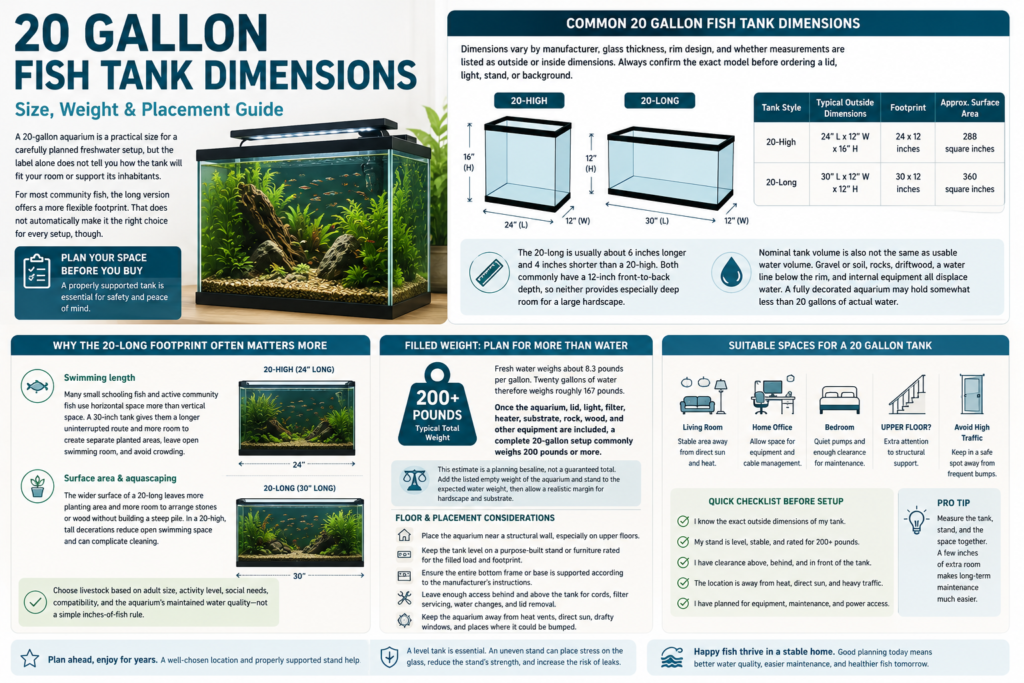
Dimensions vary by manufacturer, glass thickness, rim design, and whether measurements are listed as outside or inside dimensions. Always confirm the exact model before ordering a lid, light, stand, or background. The following measurements are common approximations for standard rectangular tanks.
| Tank style | Typical outside dimensions | Footprint | Approximate surface area |
|---|---|---|---|
| 20-high | 24 inches long x 12 inches wide x 16 inches high | 24 x 12 inches | 288 square inches |
| 20-long | 30 inches long x 12 inches wide x 12 inches high | 30 x 12 inches | 360 square inches |
The 20-long is usually about 6 inches longer and 4 inches shorter than a 20-high. Both commonly have a 12-inch front-to-back depth, so neither provides especially deep room for a large hardscape. The long tank instead distributes its volume across a broader horizontal area.
Nominal tank volume is also not the same as usable water volume. Gravel or soil, rocks, driftwood, a water line below the rim, and internal equipment all displace water. A fully decorated aquarium may hold somewhat less than 20 gallons of actual water.
Why the 20-Long Footprint Often Matters More
Aquarium volume is important, but footprint strongly affects fish behavior and maintenance. The 20-long provides about 25% more open surface area than the typical 20-high. More surface area can improve gas exchange at the water surface when there is appropriate circulation, although it does not replace regular maintenance or sensible stocking.
Swimming length
Many small schooling fish and active community fish use horizontal space more than vertical space. A 30-inch tank gives them a longer uninterrupted route than a 24-inch tank. That added length can also make it easier to create separate planted areas, leave open swimming room, and avoid crowding the filter intake and heater into the same small zone.
A 20-high can still work well for a small, thoughtfully stocked setup. Its extra height may suit an aquascape with taller plants, upright wood, or visual emphasis on vertical layers. It is usually less forgiving when planning fish that need a longer run, even if their adult size seems small.
Surface area and aquascaping
The wider surface of a 20-long leaves more planting area and more room to arrange stones or wood without building a steep pile. In a 20-high, tall decorations can look attractive, but stacking dense hardscape upward reduces open swimming space and can complicate cleaning.
Choose livestock based on adult size, activity level, social needs, compatibility, and the aquarium’s maintained water quality—not a simple inches-of-fish rule. A longer tank does not make overstocking safe, but it can offer a better layout for appropriately selected fish.
Filled Weight: Plan for More Than Water
Fresh water weighs about 8.3 pounds per gallon. Twenty gallons of water therefore weighs roughly 167 pounds. Once the aquarium, lid, light, filter, heater, substrate, rock, wood, and other equipment are included, a complete 20-gallon setup commonly weighs 200 pounds or more. Heavily planted layouts with substantial stone can weigh considerably more.
This estimate is a planning baseline, not a guaranteed total. The safest approach is to add the listed empty weight of the aquarium and stand to the expected water weight, then allow a realistic margin for hardscape and substrate. Do not assume that a dresser, cube shelf, or desk is suitable simply because the tank seems compact.
Floor and placement considerations
- Place the aquarium near a structural wall when practical, particularly in an upper-floor room.
- Keep the tank level on a purpose-built aquarium stand or furniture explicitly rated for the filled load and footprint.
- Ensure the entire bottom frame or base is supported according to the aquarium manufacturer’s instructions.
- Leave enough access behind and above the tank for cords, filter servicing, water changes, and lid removal.
- Keep the aquarium away from heat vents, direct sun, drafty windows, and places where it could be bumped.
A level tank is essential. An uneven stand can place stress on glass seams and cause water levels to look visibly tilted. Check the stand before filling, then recheck after the tank is filled and settled.
Equipment Fit and Daily Maintenance
Two tanks with the same volume can require different equipment choices. The 20-high’s 24-inch length often aligns with shorter lids and light fixtures. The 20-long generally needs equipment that spans or is designed for a 30-inch tank. Measure the available opening rather than assuming a fixture will fit because it is labeled for “20 gallons.”
Filters, heaters, and lids
Hang-on-back filters need clearance behind the aquarium and a lid with an appropriate cutout. In a narrow cabinet or against a wall, that rear clearance can determine whether the filter is practical. Internal filters save external space but use room inside the tank, which is more noticeable in a compact aquarium.
For either shape, select a heater and filter appropriate for the actual water volume, room temperature, livestock, and manufacturer guidance. Position equipment so water circulates through the tank rather than creating an overly strong current in one corner. A lid helps limit evaporation and reduces the risk of fish jumping, but it should still allow safe routing for cords and equipment.
Lighting and plant coverage
A 20-high has more water depth for light to travel through. If growing plants near the substrate, compare a light’s intended coverage and mounting height rather than relying only on its wattage or a vague “fits 20 gallon” label. A 20-long needs broader, more even coverage from end to end, while a 20-high may need sufficient intensity to reach lower plants.
Choosing the Right Stand
A stand should match the tank’s exact base dimensions, not merely its advertised gallon rating. A stand designed for a 20-high may have a 24 x 12-inch top and will not safely support a standard 30-inch 20-long. Likewise, a 30-inch stand may be too long or have unsupported edges if paired carelessly with a smaller tank.
Purpose-built aquarium stands are designed to carry a concentrated, static load. If using sturdy furniture instead, verify that the manufacturer rates it for the expected weight and that its top is flat, level, and fully supportive. Avoid makeshift supports, bowed shelving, rolling carts, and surfaces with an overhang beyond what the tank maker permits.
Common planning mistakes
- Buying the aquarium first and discovering the intended stand is too short or too shallow.
- Calculating only the weight of the water and ignoring substrate, stone, and equipment.
- Choosing a 20-high for active fish that would benefit from a longer horizontal path.
- Using a light or lid sized for a different tank length.
- Placing the tank where routine water changes and filter cleaning become difficult.
A Simple Way to Decide Between High and Long
- Measure the proposed location, including wall clearance and the space needed to open a lid or remove a filter.
- Confirm the exact aquarium dimensions and supported base requirements from the manufacturer.
- Make a livestock plan based on adult needs and behavior before choosing the tank shape.
- Estimate the complete filled weight and select a stand that supports the full footprint.
- Compare lids, lights, filters, and backgrounds by the tank’s length, width, and opening size.
Choose a 20-long when horizontal swimming room, greater surface area, and a lower, broader aquascape are priorities. Choose a 20-high when a 24-inch footprint is the firm limit and your planned animals and design do not require the added length. In either case, leaving some open space and avoiding aggressive stocking makes the aquarium easier to maintain.
Conclusion: Compare Dimensions Before You Buy
The most useful way to compare 20 gallon fish tank dimensions is to look beyond volume. A typical 20-high is compact and taller, while a typical 20-long provides more swimming length and surface area at the cost of a wider stand. Verify the exact manufacturer dimensions, plan for a filled weight above 200 pounds, and choose equipment and livestock that suit the footprint—not just the gallon label.
FAQ
Are 20-high and 20-long tanks the same volume?
They are usually both sold as nominal 20-gallon aquariums, but their shape differs. Actual water volume may vary slightly by manufacturer and will be reduced by substrate, decorations, and fill level.
How much does a filled 20-gallon fish tank weigh?
The water alone weighs about 167 pounds. With the tank, stand, substrate, hardscape, and equipment, plan for at least 200 pounds and potentially more for a heavily decorated setup.
Is a 20-long better than a 20-high for fish?
For many small, active fish, the 20-long’s 30-inch swimming length is useful. A 20-high can still be appropriate for a carefully selected, lightly stocked community or a design that benefits from extra height.
Can a regular dresser hold a 20-gallon aquarium?
Only if the furniture manufacturer explicitly rates it for the complete filled weight and the top fully supports the aquarium base. A purpose-built aquarium stand is usually the simpler and safer choice.
Helpful products to compare
Use the buying criteria above to compare suitable options for your needs.