A 10-gallon aquarium is often treated as a small, simple tank, but planning the space correctly still matters. The most common 10 gallon fish tank dimensions are easy to fit on many furniture-sized stands, yet the aquarium becomes much heavier once filled and needs room around it for equipment and routine maintenance.
Before choosing a location, confirm the actual tank measurements from the manufacturer rather than relying only on its advertised capacity. Brands vary, and a tank’s outer frame, lid, filter, background, and stand can all increase the space it occupies. A little extra planning helps prevent unstable placement, blocked equipment, and difficult water changes later.
Common 10 Gallon Fish Tank Dimensions
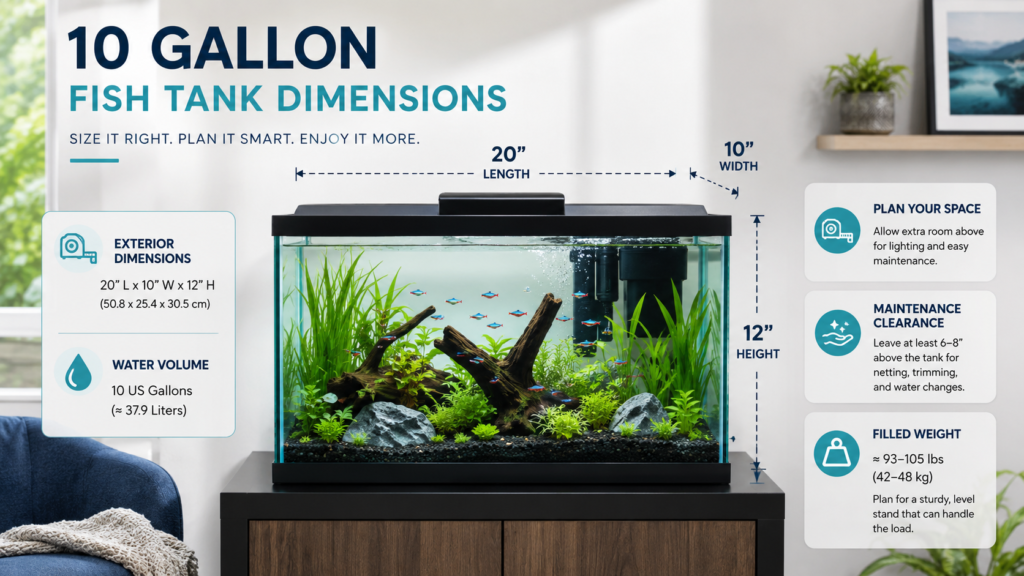
A standard rectangular 10-gallon aquarium is commonly listed at approximately 20 inches long by 10 inches wide by 12 inches high. This is the familiar long, low profile used by many basic glass aquarium kits and standalone tanks.
However, these measurements are a useful starting point, not a universal rule. Actual external dimensions can differ by brand, glass thickness, frame design, and whether the aquarium has a built-in filtration compartment. A rimmed tank may also be slightly larger at the top than the glass panel measurements suggest.
| Measurement | Typical planning estimate | Why it matters |
|---|---|---|
| Length | About 20 inches | Determines the stand top and front viewing space. |
| Width | About 10 inches | Sets the minimum front-to-back surface needed. |
| Height | About 12 inches | Affects shelf clearance, lighting access, and maintenance reach. |
| Nominal capacity | 10 gallons | Represents the tank’s rated volume, not necessarily the water it will hold in use. |
Why nominal gallons and outer measurements differ
“10 gallons” is a capacity category, not a promise that every tank holds exactly 10 gallons of water during normal use. The stated capacity may be based on internal dimensions near the upper fill line. In practice, water is usually kept below the rim, and substrate, rocks, wood, plants, and equipment take up part of the interior volume.
Measure the exact aquarium before purchasing a stand or placing it in a tight opening. If shopping in person, include the plastic rim in your measurement. If shopping online, check whether listed dimensions refer to the tank only or the full kit with a lid and filter.
How Much Does a Filled 10-Gallon Tank Weigh?
Water weighs about 8.34 pounds per gallon. Ten gallons of water alone weigh roughly 83 pounds. Once the glass tank, substrate, hardscape, lid, filter, heater, and other equipment are included, a typical operating weight is often in the range of 105 to 125 pounds.
The exact total depends on what is inside. A lightly decorated setup may stay near the lower end of that range, while a deep substrate bed or substantial stone décor can raise the weight noticeably. The tank should be treated as a heavy, permanent load rather than something that can be casually shifted after setup.
A practical weight-planning example
- Water: approximately 75 to 83 pounds, depending on the actual fill level
- Empty glass aquarium and lid: often around 10 to 15 pounds, depending on construction
- Substrate and décor: commonly 10 to 25 pounds or more
- Filter, heater, light, and small accessories: several additional pounds
For stand and furniture planning, use a conservative estimate of at least 125 pounds unless you have confirmed the weights of your particular aquarium and hardscape. It is better for the support surface to have a comfortable safety margin than to be rated only for the water weight.
Choose a Stand With the Right Footprint and Support
The stand’s usable top should fully support the aquarium’s bottom frame or base. For a standard 20-by-10-inch tank, look for a stand top that is at least that large and designed for aquarium use or for a comparable stationary load. The tank should sit flat, level, and fully supported.
A larger stand can be useful because it provides a small work surface beside the tank. Still, the aquarium itself should not be positioned so that any part of its base hangs over an unsupported edge. Even a small overhang can place uneven stress on the glass or bottom panel.
What to check before using existing furniture
- Confirm the top is level from side to side and front to back.
- Check that the furniture does not wobble, rack, or flex when pushed gently.
- Make sure the top surface is solid and continuous beneath the tank.
- Consider the loaded weight, not the empty tank weight.
- Inspect for water-sensitive materials, loose joints, or existing damage.
Bookshelves, desks, dresser tops, and floating shelves are not automatically suitable simply because the tank fits physically. Their weight ratings, construction, and support method matter. A purpose-built aquarium stand is often the straightforward choice, but any stand should be evaluated for full support and stability rather than appearance alone.
Plan Clearance Around the Aquarium
The tank’s 20-by-10-inch footprint is only part of the setup space. Leave open room above, behind, and in front of the aquarium so equipment can operate and maintenance is manageable.
Top clearance for lids and maintenance
Allow enough vertical room to remove the lid, lift out a light if needed, reach inside with a net, and add water during maintenance. A practical target is often 6 to 12 inches above the aquarium, but the needed clearance depends on the lid style, lighting mount, and nearby shelving.
A tank pushed under a low cabinet may fit on paper but become frustrating to maintain. If you cannot comfortably remove the cover or reach the bottom with a siphon, the location is probably too tight.
Rear and side clearance for equipment
Many filters, airline tubes, power cords, and heater cables exit at the back. Leave a few inches behind the aquarium when possible, especially if a filter hangs on the rear rim. Side clearance can also help if you need to access a control switch, route a drip loop, or remove equipment without moving the tank.
Do not pack the aquarium tightly between walls or furniture. Besides limiting access, a cramped location makes it harder to spot leaks, wipe the glass, and clean spilled water promptly.
Realistic Usable Water Volume
A standard 10-gallon tank rarely contains a full 10 gallons of open water after it is set up. Most aquariums are filled below the top rim to reduce splashing and allow room for a lid. Substrate and décor displace additional water.
For planning purposes, a finished setup may have roughly 8.5 to 9.5 gallons of actual water, though the result can be lower with a deep substrate layer, large rocks, or bulky internal equipment. This is normal and does not mean the tank is defective.
How to estimate your actual water volume
- Set the empty aquarium on its final, level stand.
- Add the intended substrate and hardscape before filling.
- Fill gradually to the normal operating water line.
- Track the amount of water added using a marked container or measured bucket.
- Use that measured amount as the practical water volume for maintenance planning.
This approach is more useful than guessing from the label when calculating water conditioner doses or preparing replacement water. Always follow the product’s directions and dose according to the actual amount of water being treated.
Common Space-Planning Mistakes to Avoid
The most common errors happen before the aquarium is filled. Avoiding them is usually easier than correcting them once the setup is operating.
- Measuring only the glass: Include rims, lids, filters, cords, and any rear-mounted equipment.
- Ignoring filled weight: A 10-gallon aquarium is not a lightweight tabletop decoration once water and décor are added.
- Allowing base overhang: The tank needs full support across its intended base.
- Forgetting maintenance access: Leave room to lift the lid, reach into the tank, and work with a bucket or siphon.
- Placing it in direct sun: Strong sunlight can warm the water and encourage excess algae growth.
- Choosing an unstable surface: A level, rigid stand is more important than finding the smallest possible footprint.
Also consider nearby outlets. Aquarium equipment should be connected with cords arranged in drip loops, so water running down a cord cannot easily reach the outlet or plug connection.
Final Checklist for 10 Gallon Fish Tank Dimensions
Before setting up the aquarium, confirm the manufacturer’s external measurements, then compare them with the available stand and room around it. Plan for a typical tank size of about 20 by 10 by 12 inches, a filled weight around 105 to 125 pounds, and several inches of clearance for rear equipment and top access.
The key to working with 10 gallon fish tank dimensions is to plan for the complete setup rather than the empty glass box. A stable stand, full base support, practical maintenance access, and a realistic estimate of usable water volume will make the aquarium easier to manage from day one.
FAQ
Are all 10-gallon fish tanks 20 inches long?
No. About 20 by 10 by 12 inches is a common standard size, but dimensions vary among brands and tank designs. Check the listed external measurements for the specific aquarium.
Can a 10-gallon aquarium sit on a 20-by-10-inch stand?
Yes, if the stand is level, stable, rated for the filled load, and supports the entire aquarium base without overhang. A slightly larger top can make maintenance more convenient.
How much space should be left behind a 10-gallon tank?
Leave enough space for the filter, cords, tubing, and access to the back glass. A few inches is often practical, but rear-mounted equipment may require more.
Does a 10-gallon tank really hold 10 gallons of water?
Its nominal capacity is 10 gallons, but the operating water volume is usually lower because of fill height, substrate, décor, and equipment displacement.
Helpful products to compare
Use the buying criteria above to compare suitable options for your needs.