Sponge Filter vs HOB Filter: Which Is Better for Your Aquarium?
Choosing between a sponge filter and a HOB filter comes down to what your aquarium needs most.
A sponge filter is usually the better choice for shrimp, fry, bettas, breeding tanks, and aquariums where gentle flow and safe intake matter most.
A HOB filter — short for hang-on-back filter — is often better for community aquariums where stronger mechanical filtration, better circulation, and flexible filter media are priorities.
Quick answer: Choose a sponge filter for gentle, shrimp- and fry-safe biological filtration. Choose a HOB filter when you want stronger debris removal, more circulation, and customizable filter media. In some aquariums, using both gives you the advantages of each.
Sponge Filter vs HOB Filter: Quick Comparison
| Feature | Sponge Filter | HOB Filter | Better Choice |
|---|---|---|---|
| Biological filtration | Excellent | Excellent | Tie |
| Mechanical filtration | Moderate | Usually stronger | HOB |
| Gentle flow | Excellent | Depends on model | Sponge |
| Shrimp and fry safety | Excellent | Intake may need a sponge | Sponge |
| Filter media flexibility | Limited | Very good | HOB |
| Water circulation | Gentle to moderate | Moderate to strong | HOB |
| Surface agitation | Good | Good | Tie |
| Maintenance | Very simple | Simple, but more parts | Sponge |
| Running cost | Very low | Low to moderate | Sponge |
| Equipment inside tank | More visible | Mostly outside tank | HOB |
| Best for bettas | Excellent | Good with flow control | Sponge |
| Best for shrimp | Excellent | Good with pre-filter sponge | Sponge |
| Best for community tanks | Good | Excellent | HOB |
Sponge Filter vs HOB Filter: The Main Difference
The biggest difference is how each filter moves water and handles debris.
A sponge filter draws water gently through a porous sponge. The sponge catches some debris while also providing a large surface area for beneficial bacteria.
A HOB filter actively pulls water through an intake tube, passes it through one or more types of filter media, and returns it to the aquarium.
That generally gives a HOB filter an advantage in mechanical filtration and circulation, while a sponge filter has an advantage in gentle flow, simplicity, and safety for small livestock.
Neither design is automatically better.
The better filter is the one that matches your aquarium’s livestock, size, feeding level, and maintenance needs.
How Does a Sponge Filter Work?
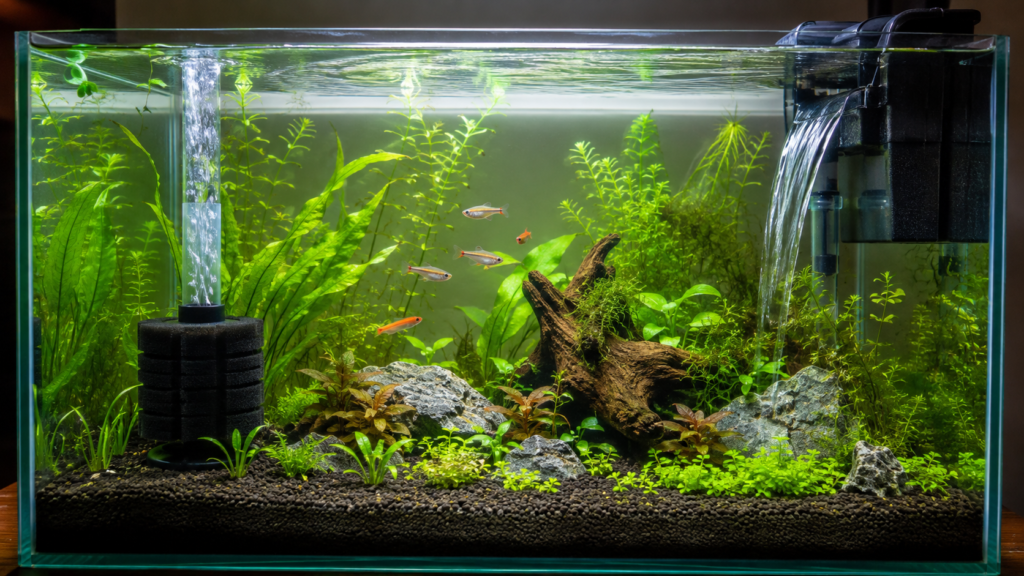
A traditional sponge filter sits inside the aquarium and is powered by an external air pump.
Air travels through airline tubing into the filter. As bubbles rise through the uplift tube, they move water through the sponge.
The sponge performs two important jobs.
First, it traps suspended debris.
Second, its porous surface provides space for beneficial bacteria that support biological filtration.
Because water is drawn through a broad sponge rather than a narrow intake tube, suction is relatively gentle.
That makes sponge filters especially useful for:
- shrimp and shrimplets
- baby fish and fry
- bettas
- breeding tanks
- nano aquariums
- fish that prefer lower flow
The bubbles also create surface movement, helping promote gas exchange.
If you are setting one up, see our guide to choosing the best air pump for a sponge filter.
How Does a HOB Filter Work?
A HOB filter, or hang-on-back filter, hangs over the rim of the aquarium.
An electric impeller pulls aquarium water through an intake tube and into the filter chamber.
The water then passes through filter media before flowing back into the aquarium.
Depending on the filter design, the chamber may contain:
- coarse sponge for larger debris
- fine mechanical media for smaller particles
- ceramic or other permanent biological media
- activated carbon or other optional chemical media
The main advantage of a HOB is flexibility.
Many HOB filters allow you to use several media types at the same time. Their water return also creates useful circulation and surface agitation.
Sponge Filter Pros and Cons
Pros
- Gentle water flow
- Excellent biological filtration
- Safe intake for shrimp and fry
- Very simple design
- Easy maintenance
- Low operating cost
- Provides aeration and surface movement
- Few moving parts
- Useful in breeding and quarantine setups
Cons
- Mechanical filtration is relatively limited
- Less effective at fine water polishing
- Takes up space inside the aquarium
- Usually requires a separate air pump
- Limited filter media customization
HOB Filter Pros and Cons
Pros
- Strong mechanical filtration
- Better removal of suspended debris
- Good water circulation
- Flexible media options
- Easy access to the filter chamber
- Most of the filter remains outside the tank
- Can combine mechanical and biological media
- Works well for many community aquariums
Cons
- Flow may be too strong for some fish
- Intake may need a pre-filter sponge for shrimp or fry
- More moving parts than a sponge filter
- May produce motor or waterfall noise
- Some designs rely heavily on disposable cartridges
- Usually costs more to buy and operate than a basic sponge setup
Which Has Better Biological Filtration?
Winner: Tie
Both sponge filters and HOB filters can provide excellent biological filtration.
A mature sponge offers a large porous surface exposed to oxygenated aquarium water, creating a suitable environment for nitrifying bacteria.
A HOB can also provide substantial biological filtration when it contains permanent sponge, ceramic media, or other reusable biological media.
The important factor is not simply whether the filter is a sponge or HOB.
What matters more is:
- how much biological media is available
- whether enough water passes through it
- whether the media remains established
- how the filter is maintained
Avoid replacing all mature biological media at the same time.
If a large portion of the aquarium’s beneficial bacteria is living in a sponge, cartridge, or ceramic media and you remove all of it at once, biological filtration can be reduced.
Reusable biological media should generally be preserved rather than routinely discarded.
Which Keeps Aquarium Water Clearer?
Winner: HOB filter
A HOB filter usually has the advantage when your main goal is removing visible suspended particles.
Water is pulled through concentrated mechanical media, and many HOB filters can also use fine pads or polishing media.
A sponge filter catches debris too, but its main strengths are gentle flow and biological filtration rather than fine mechanical polishing.
For a lightly stocked shrimp aquarium, a sponge filter may provide all the filtration you need.
For a community aquarium with more fish, heavier feeding, or more suspended debris, a HOB can make maintaining visibly clear water easier.
Which Is Better for Shrimp?
Winner: Sponge filter
For most shrimp tanks, a sponge filter is the safer and more practical choice.
Shrimplets can be extremely small. A conventional HOB intake can create unnecessary risk unless it is protected.
A sponge filter distributes suction across a much larger surface, producing gentler intake flow.
The sponge also develops biofilm that shrimp may graze on.
A HOB can still work well in a shrimp tank, but adding a suitable pre-filter sponge over the intake is strongly recommended for small shrimp and shrimplets.
For smaller aquariums, see our Best Nano Aquarium Filter guide.
Which Is Better for Bettas?
Winner: Sponge filter
Sponge filters are one of the easiest filtration choices for betta aquariums because they naturally produce gentle flow.
Bettas — particularly long-finned varieties — may struggle when they must constantly swim against a strong current.
That does not mean a HOB is a bad choice.
A HOB with adjustable flow can work very well when properly set up.
You can also:
- reduce the output flow
- add a pre-filter sponge to the intake
- redirect the return
- keep the water level high to soften the waterfall effect
The goal is not zero water movement.
You want enough circulation and surface movement for filtration and gas exchange without creating a current the fish must continuously fight.
See our Best Betta Aquarium Filter guide for more options.
Which Is Better for Fry and Breeding Tanks?
Winner: Sponge filter
Sponge filters are especially useful in breeding and grow-out aquariums.
Their broad intake surface creates gentle suction, reducing the risk to small fry.
They also provide biological filtration without introducing a powerful current.
Another practical advantage is that a mature sponge filter can be moved between compatible aquarium setups when needed.
For breeding tanks where simplicity and fry safety are priorities, a sponge filter is difficult to beat.
Which Filter Has Better Media Options?
Winner: HOB filter
HOB filters offer significantly more flexibility.
A typical HOB setup might use:
- coarse sponge for larger debris
- fine mechanical media for smaller particles
- ceramic biological media kept in the filter long term
Optional chemical media can also be used temporarily when there is a specific reason for it.
A traditional sponge filter is much simpler.
The sponge itself provides both mechanical and biological filtration, which is convenient but gives you fewer customization options.
If you enjoy fine-tuning your filtration system, the HOB has the clear advantage.
Which Provides Better Water Circulation?
Winner: HOB for stronger flow; sponge for gentle flow
A HOB filter usually produces stronger overall circulation.
Its intake draws water from one area of the aquarium while the return pushes filtered water back across the surface.
That can be useful in larger or more heavily stocked community aquariums.
A sponge filter creates much gentler water movement.
For bettas, shrimp, fry, and other livestock that prefers calmer conditions, that is an advantage rather than a weakness.
Choose based on the animals in the tank, not simply on which filter moves the most water.
Which Provides Better Oxygenation?
Winner: Depends on surface movement
Both filter types can help promote gas exchange when they create adequate surface agitation.
A sponge filter moves water upward with bubbles, disturbing the water surface.
A HOB creates surface movement as filtered water returns to the tank.
In either case, surface agitation is more important than simply seeing bubbles.
A properly set up sponge filter or HOB can provide useful water movement at the surface.
Which Filter Is Quieter?
Winner: Depends on the equipment
Neither type is automatically silent.
With a sponge filter, most noise comes from:
- the air pump
- vibration
- bubbles breaking at the surface
A quality air pump placed on a stable surface can be very quiet.
With a HOB filter, noise may come from:
- the electric impeller
- vibration
- water flowing back into the aquarium
When the aquarium water level drops, the HOB return may become noticeably louder.
Keeping the water level close to the filter outlet usually helps reduce waterfall noise.
For a bedroom aquarium, both pump vibration and water-return noise are worth considering.
Which Is Easier to Maintain?
Winner: Sponge filter
Both filter types are relatively easy to maintain, but a sponge filter has fewer parts.
How to Clean a Sponge Filter
During a routine water change:
- Remove some aquarium water into a bucket.
- Take the sponge out of the tank.
- Gently squeeze it several times in the removed aquarium water.
- Return it to the aquarium.
The goal is to remove excessive debris, not sterilize the sponge.
A mature filter sponge does not need to look brand new.
How to Maintain a HOB Filter
Typical HOB maintenance may include:
- rinsing reusable mechanical media
- cleaning the intake tube
- removing debris from the impeller
- gently rinsing permanent biological media when needed
- replacing genuinely exhausted disposable media when appropriate
Avoid replacing every piece of mature filter media at once.
Which Costs Less?
Winner: Sponge filter
A basic sponge filter is usually inexpensive to buy and operate.
The filter itself contains no electric motor and is powered by an external air pump.
A HOB uses an electric impeller and may also involve additional costs for replacement media depending on its design.
You do not necessarily need to replace filter media simply because a manufacturer sells replacement cartridges.
Reusable sponge and biological media can often remain in service for much longer when they are maintained appropriately.
For aquarists prioritizing low cost and simplicity, a sponge filter has a clear advantage.
What Happens During a Power Outage?
Neither a standard sponge filter nor a standard HOB will continue operating normally without electricity.
A sponge filter stops when its air pump stops.
A HOB stops when the impeller loses power.
Depending on the HOB design, water level, and outage duration, the filter may also need to refill or restart correctly once power returns.
If power outages are a concern, a battery-powered or backup air pump can be particularly useful with a sponge filter.
Sponge Filter vs HOB for a 5-Gallon Tank
Best default for most betta or shrimp tanks: Sponge filter
For many 5-gallon freshwater aquariums, a small sponge filter is the safer default.
This tank size is commonly used for shrimp and bettas, both of which generally benefit from controlled flow.
A small HOB can also work if you want stronger mechanical filtration, but flow becomes especially important in such a small volume of water.
A filter that feels gentle in a larger aquarium can create substantial current in a 5-gallon tank.
Sponge Filter vs HOB for a 10-Gallon Tank
Best choice: Depends on livestock
Both filters can work very well in a 10-gallon aquarium.
Choose a sponge filter for:
- shrimp
- bettas
- fry
- breeding setups
- fish that prefer gentle flow
Choose a HOB for:
- small community tanks
- stronger mechanical filtration
- more circulation
- customizable media
- less equipment inside the aquarium
Tank dimensions and livestock matter more than simply choosing the filter with the highest advertised gallon rating.
Sponge Filter vs HOB for a 20-Gallon Tank
Best default for many community tanks: HOB filter
A HOB often becomes more attractive as aquarium size and stocking level increase.
A typical 20-gallon community aquarium may benefit from stronger circulation and better mechanical debris removal.
However, a properly sized sponge filter — or more than one sponge filter — can still provide excellent biological filtration.
Sponge filters are not limited to nano tanks.
Their main limitation in larger setups is often circulation and mechanical debris removal rather than biological filtration.
Can You Use a Sponge Filter and HOB Together?
Yes.
In some aquariums, using both is an excellent setup.
The HOB can handle:
- stronger mechanical filtration
- water circulation
- customizable filter media
The sponge filter can add:
- biological filtration
- aeration
- gentle secondary filtration
- shrimp-safe intake
- established backup filter media
Using both can make sense in:
- community aquariums
- shrimp-friendly community tanks
- breeding setups
- aquariums where backup biological media is useful
You do not need two filters simply because more filtration sounds better.
Use both when each filter solves a real problem in the aquarium.
Common Sponge Filter Mistakes
Using Too Much Airflow
More bubbles do not automatically mean better filtration.
Excessive airflow may create unnecessary turbulence and noise.
Choosing a Sponge That Is Too Small
The filter still needs enough sponge surface and circulation for the aquarium’s livestock and feeding level.
Cleaning the Sponge Too Aggressively
The goal is to remove accumulated debris while preserving established biological media.
Ignoring the Air System
Blocked tubing, loose connections, or a weak air pump can reduce filter performance.
Common HOB Filter Mistakes
Choosing a Filter Only by Maximum Flow
More flow is not automatically better.
This is especially important for bettas, shrimp, nano tanks, and other low-flow setups.
Leaving the Intake Unprotected
Shrimp, shrimplets, and small fry may benefit from a pre-filter sponge.
Replacing All Filter Media at Once
Removing all mature media simultaneously may unnecessarily reduce established biological filtration.
Replacing Reusable Media Too Often
Permanent biological media should generally be maintained rather than routinely discarded simply because replacement media is available.
Letting the Water Level Drop Too Low
A lower water level may make the HOB louder and alter how the return moves water through the aquarium.
Sponge Filter vs HOB Filter: Final Verdict
There is no universal winner.
For shrimp, fry, bettas, breeding tanks, and many nano aquariums, a sponge filter is usually the better choice.
It provides:
- gentle flow
- safe intake
- excellent biological filtration
- simple maintenance
- low operating cost
For a typical freshwater community aquarium, a HOB filter often provides a better overall balance.
It offers:
- stronger mechanical filtration
- better debris removal
- stronger circulation
- customizable filter media
- easy access for maintenance
Choose a Sponge Filter If:
- you keep shrimp or fry
- you have a betta or low-flow fish
- gentle filtration is a priority
- you want a simple and inexpensive setup
- biological filtration matters more than fine water polishing
Choose a HOB Filter If:
- you keep a community aquarium
- you want stronger mechanical filtration
- visible debris is a recurring issue
- you want several types of filter media
- stronger circulation is useful in your tank
Use Both If:
- you want the HOB for mechanical filtration and circulation
- you want additional biological filtration and aeration
- you want mature backup filter media
- your livestock benefits from a sponge while the aquarium still needs stronger circulation
The best filter is not necessarily the one with the highest advertised flow rate.
It is the one that provides stable biological filtration, appropriate water movement, safe intake design, effective debris removal, and maintenance you can perform consistently.
Frequently Asked Questions
Is a Sponge Filter Enough for a Fish Tank?
Yes. A properly sized and mature sponge filter can provide sufficient biological filtration for many freshwater aquariums, particularly lightly or moderately stocked tanks.
Is a Sponge Filter Better Than a HOB Filter?
A sponge filter is generally better for shrimp, fry, bettas, breeding tanks, and low-flow aquariums. A HOB is often better for community tanks where stronger mechanical filtration, circulation, and media flexibility are more important.
Do HOB Filters Filter Better Than Sponge Filters?
Not in every category. HOB filters usually perform better at mechanical filtration and debris removal. Sponge filters are excellent biological filters and provide much gentler intake flow.
Is a Sponge Filter Better Than a HOB for a 5-Gallon Tank?
For most 5-gallon betta or shrimp aquariums, a sponge filter is usually the safer default because of its gentle flow. A small adjustable HOB can also work when stronger mechanical filtration is needed.
Is a Sponge Filter Better Than a HOB for a 10-Gallon Tank?
It depends on the livestock. A sponge filter is often better for shrimp, bettas, and fry, while a HOB may be more useful in a small community aquarium where stronger debris removal is important.
Is a Sponge Filter Enough for a 20-Gallon Tank?
It can be. A properly sized sponge filter — or multiple sponge filters — can provide effective biological filtration in a 20-gallon aquarium. A HOB may still be preferable when stronger circulation and mechanical filtration are needed.
Do HOB Filters Oxygenate Aquarium Water?
A HOB can improve gas exchange by disturbing the water surface as filtered water returns to the aquarium.
Do Sponge Filters Oxygenate Water?
Sponge filters create bubbles and water movement that disturb the surface, which can help promote gas exchange.
Do Sponge Filters Keep Water Clear?
Sponge filters trap debris, but they are generally stronger at biological filtration than fine mechanical water polishing. A HOB with fine mechanical media may produce visibly clearer water in tanks with more suspended particles.
Are HOB Filters Safe for Shrimp?
They can be, but a suitable pre-filter sponge over the intake is strongly recommended for small shrimp and shrimplets.
Does a Sponge Filter Need an Air Pump?
Most traditional sponge filters do. You normally need an air pump, airline tubing, and often a check valve.
Can a Sponge Filter Replace a HOB?
Yes, provided the sponge filter is appropriately sized for the aquarium and livestock.
When replacing an established HOB, avoid removing mature biological filtration abruptly. Running both filters together during the transition can give the new filter time to establish biological media.
Can You Run a HOB and Sponge Filter at the Same Time?
Yes. The two filters can complement each other. The HOB can provide stronger mechanical filtration and circulation, while the sponge filter adds gentle biological filtration and aeration.
How Often Should You Clean a Sponge Filter?
There is no universal schedule. Clean it when accumulated debris begins to restrict water flow or filtration performance. Gently squeezing it in removed aquarium water during a water change is usually sufficient.
Do You Need to Replace HOB Filter Cartridges Every Month?
Not necessarily. Biological media should generally be preserved rather than replaced simply according to a calendar. Reusable sponge and biological media can often be cleaned and maintained, while exhausted disposable media should be replaced when appropriate.