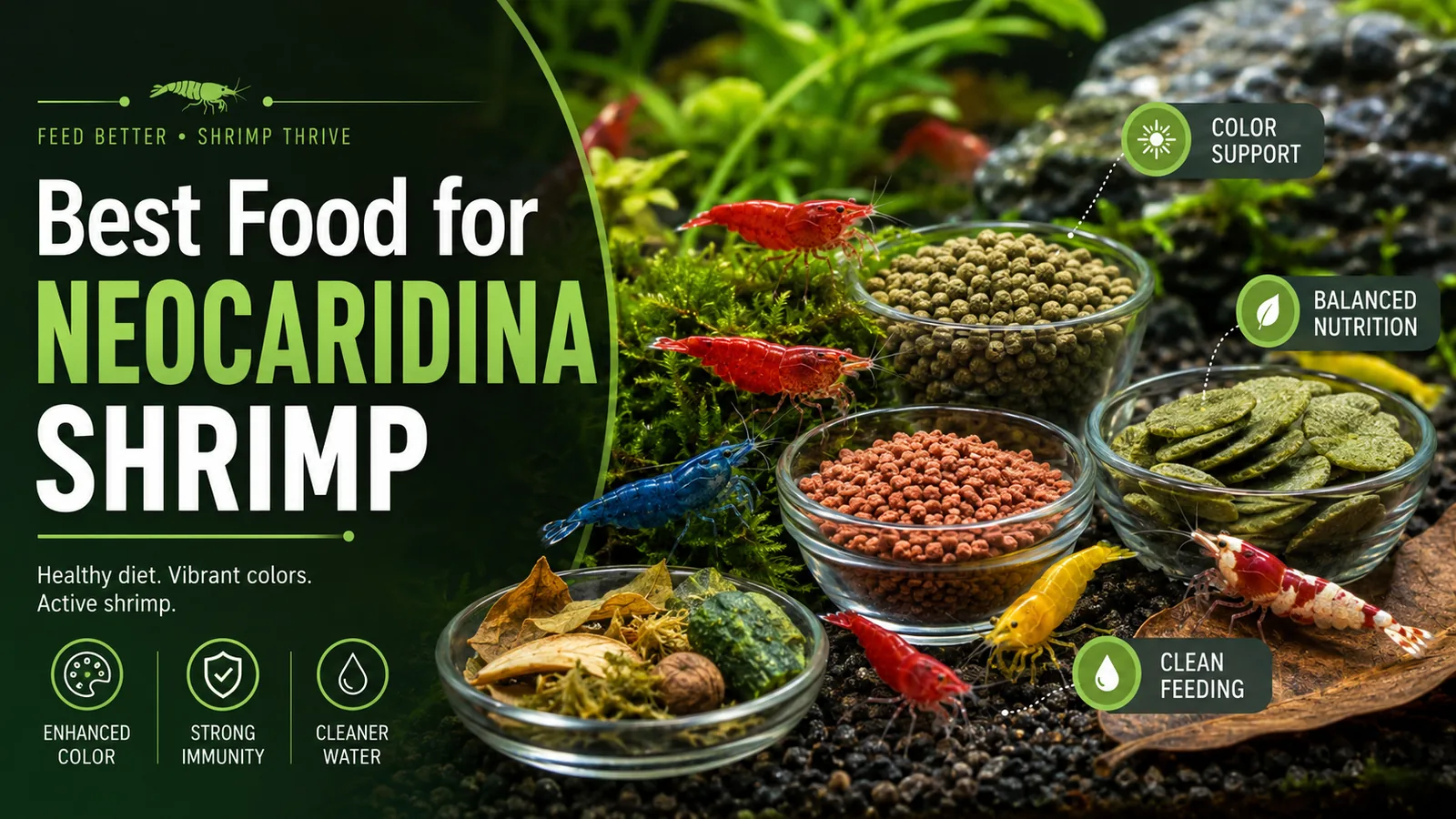
A good shrimp diet combines a complete sinking food with natural grazing and occasional variety. Feed less than you think: leftover food can become a water-quality problem faster than underfeeding in a mature tank.
Neocaridina do not need a constant rain of commercial food. A healthy colony spends much of the day grazing on biofilm, algae and microorganisms, so prepared food works best as a controlled supplement that fills nutritional gaps without leaving excess waste behind.
Quick picks
These products represent common shrimp-food formats rather than a single universal winner. Look for a food that matches your colony size, breaks down at a useful rate and can be portioned accurately enough that leftovers are easy to remove.
| Product | Best for | Why it stands out |
|---|---|---|
| Fluval Bug Bites Shrimp Micro Granules | Best everyday granule | A shrimp-specific micro-granule food formulated for freshwater shrimp and sized for small invertebrates. |
| Hikari Shrimp Cuisine | Best compact pellet | A small sinking food made for ornamental freshwater shrimp including Neocaridina. |
| GlasGarten Bacter AE | Best biofilm support | A micro-powder product intended to encourage biofilm and provide a fine food source, especially useful in shrimp-focused tanks. |
Fluval Bug Bites Shrimp Micro Granules
A shrimp-specific micro-granule food formulated for freshwater shrimp and sized for small invertebrates.
- Small granules
- Daily-feeding format
- Freshwater shrimp formula
Price and availability can change. Check the retailer for current details.
Hikari Shrimp Cuisine
A small sinking food made for ornamental freshwater shrimp including Neocaridina.
- Sinking pellets
- Shrimp-sized pieces
- Useful staple food
Price and availability can change. Check the retailer for current details.
GlasGarten Bacter AE
A micro-powder product intended to encourage biofilm and provide a fine food source, especially useful in shrimp-focused tanks.
- Biofilm support
- Fine powder
- Popular in shrimp keeping
Price and availability can change. Check the retailer for current details.
How to Choose Food for Neocaridina Shrimp
The most useful shrimp food is one the colony can reach and finish without fouling the aquarium. Ingredient quality matters, but feeding control—portion size, distribution and how long the food sits in water—is just as important in a small tank.
Particle size
Small pellets, wafers and powders behave differently. A wafer can concentrate the colony in one place for easy observation, while a fine food spreads across moss and hardscape and can reach shy juveniles more easily.
Ingredients
A varied formula with plant material, protein sources and minerals is more useful than relying on one ingredient as a marketing hook. Commercial food should complement the natural grazing already available in the aquarium.
Water stability
Choose food that remains edible long enough for shrimp to graze without turning into a cloud of fine waste. Anything left untouched after the feeding window should be easy to remove.
Colony size
A growing colony can consume much more than a new group of ten shrimp. Adjust portions to the number of active animals you actually see rather than following a fixed dose that ignores tank maturity.
What matters in a real setup
Healthy shrimp browse on algae, microorganisms, decaying plant matter and biofilm. Prepared food is most useful as a measured supplement that makes nutrition predictable and helps you observe the colony at feeding time.
Watch the colony, not the clock. If shrimp rush to a feeding dish and finish the food quickly, the portion is probably close. If pieces remain for hours while shrimp ignore them, reduce the amount before increasing feeding frequency.
Setup and maintenance tips
- Start with a tiny portion and remove uneaten food after a few hours.
- Use a feeding dish if you want to keep crumbs out of aquasoil.
- Rotate a staple food with occasional vegetable or leaf-based foods.
- Reduce feeding after adding new botanicals or when visible biofilm is abundant.
Rotate foods instead of feeding the same product at every meal, and use a small dish when possible so leftovers can be removed easily. New shrimp keepers usually get better water quality by underfeeding slightly than by trying to make sure every shrimp is visibly eating commercial food each day.
Common mistakes to avoid
Feeding every time shrimp gather at the glass. This can add unnecessary stress or cleanup. Choose the gentler method first and increase intensity only when the tank clearly needs it.
Leaving a large wafer overnight in a small tank. It is safer to solve the specific problem than to overcorrect the whole aquarium. Keep the adjustment proportional to what you are actually seeing.
Using only high-protein food because it produces fast feeding responses. That choice often removes more margin for error than it adds benefit. Favor a repeatable routine that is easy to monitor.
FAQ
How often should I feed Neocaridina shrimp?
In a mature tank, many keepers feed a small prepared portion several times per week rather than heavily every day.
Can shrimp live on biofilm alone?
A mature tank can provide a lot of natural food, but a balanced prepared food adds nutritional consistency.
How much food should I give?
Start very small. The right amount is what the colony consumes without visible leftovers building up in the substrate.
Final verdict
Pick one reliable staple, feed lightly, and let the aquarium do part of the work. For Neocaridina, stable water and a mature grazing surface matter at least as much as the brand on the food jar.
Check the current ingredient list and package directions, but treat them as a starting point rather than a fixed feeding rule. The best Neocaridina diet combines natural grazing, modest prepared-food portions and stable water quality.