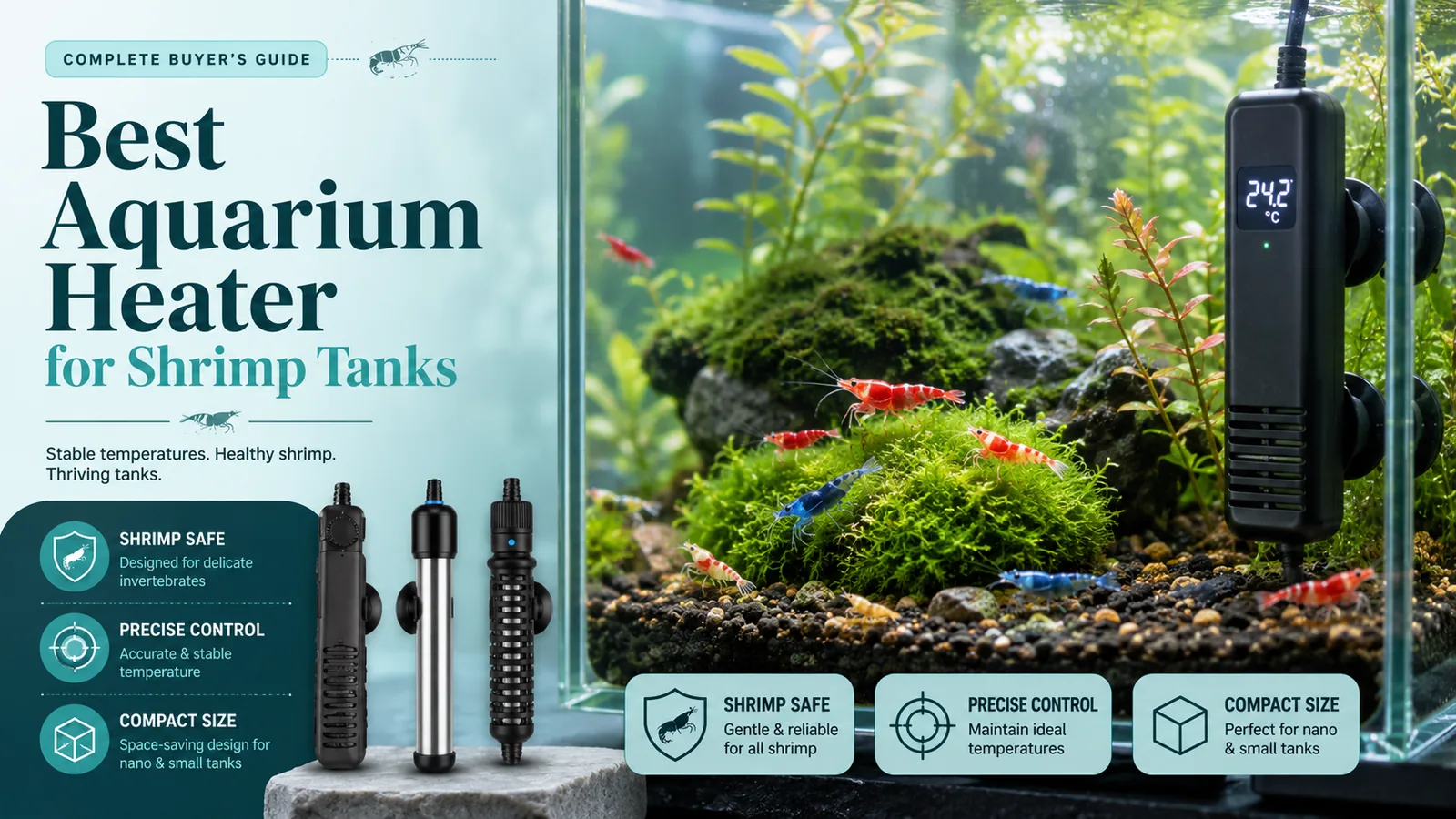
For Neocaridina, a heater is mainly about preventing large swings when the room gets cool. Choose the smallest reliable adjustable heater that can hold the tank steady without running far above the needed wattage.
A shrimp heater should solve a temperature problem, not create one. Many Neocaridina aquariums do well at normal room temperature, so the best heater is often a modest, controllable unit used to prevent winter drops or repeated daily swings rather than to keep the tank unusually warm.
Quick picks
These picks cover a traditional adjustable heater, a compact digital-style option and a feature-rich alternative. The important comparison is not the number of buttons; it is whether the heater is appropriately sized, controllable and easy to verify with a separate thermometer.
| Product | Best for | Why it stands out |
|---|---|---|
| EHEIM thermocontrol Aquarium Heater | Best traditional adjustable heater | A long-running adjustable heater line with precise temperature control and multiple sizes for different aquarium volumes. |
| NICREW Aquarium BH Heater | Best compact digital-style option | A compact heater family from a freshwater equipment brand, useful where a smaller footprint matters. |
| hygger Submersible Aquarium Heater | Best feature-rich option | A popular digital-style heater family with models aimed at common home aquarium sizes. |
EHEIM thermocontrol Aquarium Heater
A long-running adjustable heater line with precise temperature control and multiple sizes for different aquarium volumes.
- Adjustable temperature
- Multiple wattages
- Freshwater and marine use
Price and availability can change. Check the retailer for current details.
NICREW Aquarium BH Heater
A compact heater family from a freshwater equipment brand, useful where a smaller footprint matters.
- Compact body
- Easy temperature checks
- Useful for smaller tanks
Price and availability can change. Check the retailer for current details.
hygger Submersible Aquarium Heater
A popular digital-style heater family with models aimed at common home aquarium sizes.
- Digital controls
- Multiple size options
- Easy set point changes
Price and availability can change. Check the retailer for current details.
How to Choose a Shrimp Tank Heater
Start by measuring the room and tank temperature for several days. If the aquarium is already stable in a suitable range, extra heat may be unnecessary. When a heater is justified, choose enough wattage to maintain the target without dramatically oversizing a small volume of water.
Stable control
A stable thermostat is more useful than a very high maximum temperature. Shrimp generally cope better with a steady environment than with repeated overshoot and correction cycles.
Wattage
Small tanks change temperature quickly, which makes excessive wattage less forgiving. Match the heater to both water volume and the difference between room temperature and the temperature you actually want to maintain.
Physical protection
Place the heater where shrimp cannot be trapped against a hot surface and where the unit remains fully immersed according to its instructions. A guard can be useful on some designs, but good placement and correct sizing are the first line of protection.
Verification
Never rely on the heater display alone. A separate aquarium thermometer gives you an independent check and makes it easier to catch a thermostat that is reading differently from the actual water temperature.
What matters in a real setup
Many Neocaridina tanks are comfortable at normal indoor temperatures, so do not add heat automatically. If the room stays stable, extra hardware may be unnecessary. The heater becomes useful when winter temperatures drop or the tank experiences repeated daily swings.
Heater placement should work with the tank’s circulation. Putting the unit near gentle filter flow helps distribute warmed water instead of creating a hot pocket. It should also be easy to see and unplug before a water change lowers the water level.
Setup and maintenance tips
- Match wattage to both tank volume and room temperature.
- Place the heater near gentle circulation so warmed water disperses evenly.
- Verify the tank with a separate thermometer for several days after installation.
- Unplug a heater before draining water below its minimum immersion line.
For the first few days, compare the heater setting with an independent thermometer at different times of day. Make small adjustments and give the tank time to stabilize before changing the setting again.
Common mistakes to avoid
Heating a shrimp tank simply because tropical fish tanks use heaters. A heater is not automatically required. If the room keeps the aquarium stable, unnecessary heating adds equipment and another potential failure point without solving a real problem.
Using a high-wattage heater in a very small tank. A powerful heater can change a small volume of water quickly. Choose a size appropriate to the aquarium and the actual room-to-tank temperature difference.
Setting the thermostat and never checking it with a second thermometer. Thermostat markings and digital displays are not a substitute for verification. Keep an independent thermometer in the tank and compare readings regularly.
FAQ
What temperature is best for Neocaridina shrimp?
Many Neocaridina colonies do well in the low-to-mid 70s °F, but stability matters and local strain conditions vary.
Does every shrimp tank need a heater?
No. If the room stays in a suitable, stable range, a heater may not be needed.
Can a heater hurt shrimp?
A correctly installed heater is normally fine, but overheating and sudden temperature changes can be dangerous, which is why independent monitoring matters.
Final verdict
Use a heater to solve a real temperature-stability problem, not because it feels like mandatory aquarium equipment. For small shrimp tanks, controlled and modest is better than oversized.
Confirm the current wattage options, minimum water level and control method before purchase. For shrimp, stable and verifiable temperature control is more important than a long list of heating modes.