For a betta, precise small portions matter more than hopper capacity. Test any feeder for several days while you are still home before trusting it during a trip.
Automatic feeders can work for bettas, but the challenge is portion control. A device that releases a large pinch twice a day may be fine for a community tank and completely unsuitable for one fish, so the smallest repeatable dose matters more than hopper capacity.
Quick picks
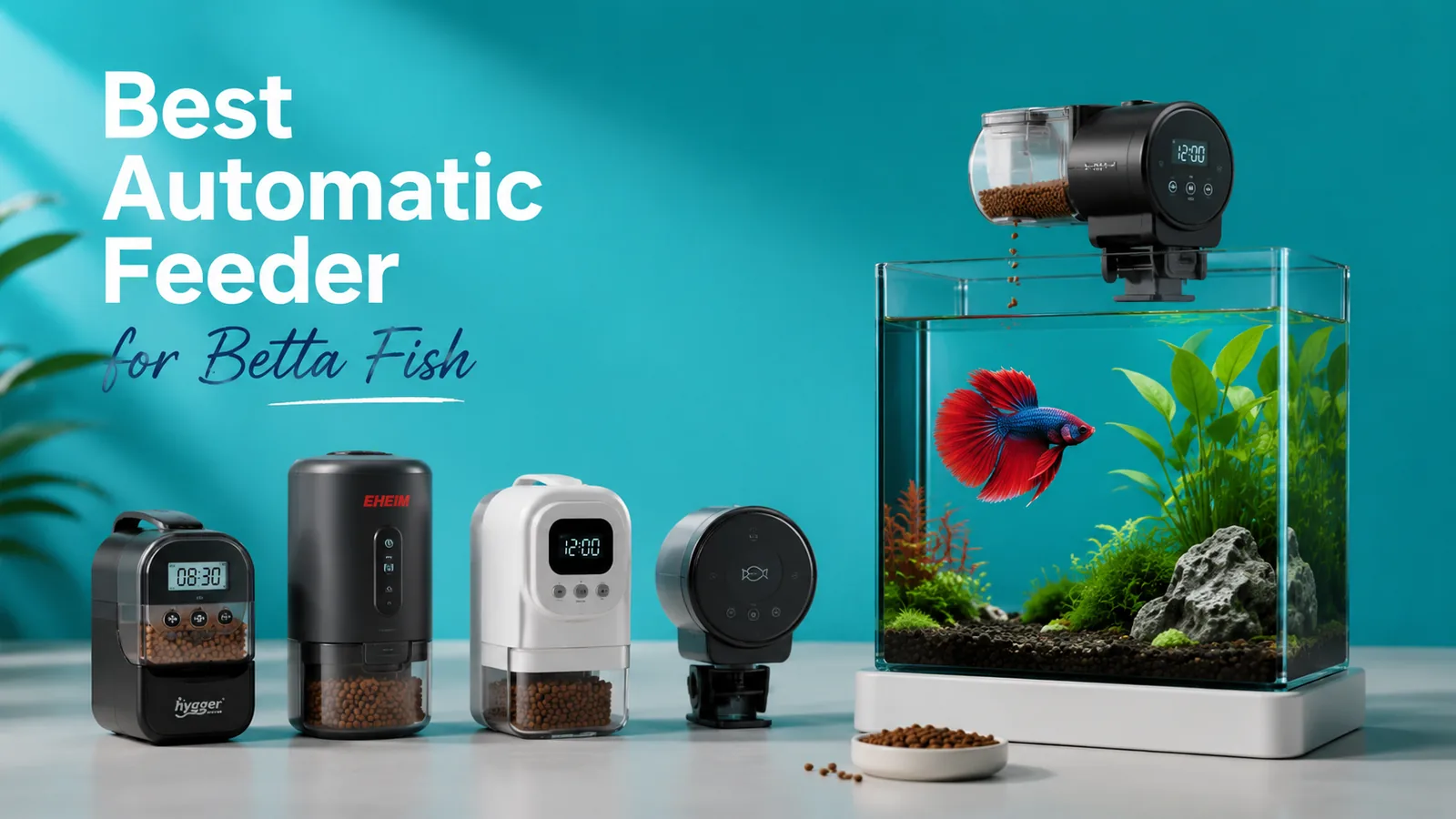
These feeders use different dispensing mechanisms and mounting styles. Before choosing one, test whether it can release a consistently small portion of the exact pellet or granule you feed your betta.
| Product | Best for | Why it stands out |
|---|---|---|
| hygger 082 Smart Fish Feeder | Best smart feeder | A connected feeder model with scheduling and remote-control features aimed at hands-off feeding. |
| EHEIM Everyday Fish Feeder | Best simple automatic feeder | A classic drum-style automatic feeder for dry foods when reliability matters more than smart-home extras. |
| Fish Mate F14 Aquarium Fish Feeder | Best for portion planning | A tray-style feeder that separates meals into individual compartments, helpful when portion control matters. |
hygger 082 Smart Fish Feeder
A connected feeder model with scheduling and remote-control features aimed at hands-off feeding.
- Scheduled feeding
- App-oriented features
- Large food chamber
Price and availability can change. Check the retailer for current details.
EHEIM Everyday Fish Feeder
A classic drum-style automatic feeder for dry foods when reliability matters more than smart-home extras.
- Simple programming
- Ventilated drum design
- Good for pellets and flakes
Price and availability can change. Check the retailer for current details.
Fish Mate F14 Aquarium Fish Feeder
A tray-style feeder that separates meals into individual compartments, helpful when portion control matters.
- Individual meal compartments
- Useful for mixed foods
- Clear portion planning
Price and availability can change. Check the retailer for current details.
How to Choose an Automatic Feeder for a Betta
For a single betta, reliability means dispensing less, not more. The feeder should keep food dry, mount securely over the aquarium and deliver a small repeatable amount without relying on flakes that change shape and settle unpredictably in the drum.
Minimum portion
The smallest controllable opening or feed chamber is the most important specification. Test several cycles over a plate before the feeder ever goes above the aquarium.
Food compatibility
Uniform pellets and small granules usually dispense more consistently than large mixed flakes. Whatever food you use, test it in the feeder because humidity and particle shape can change the portion.
Moisture control
Food absorbs humidity quickly above an aquarium. A covered hopper, sensible mounting position and a feeder that does not sit directly over heavy condensation reduce clumping.
Mounting
The feeder needs to stay level and secure on the lid or rim. Check that the opening actually drops food into the water instead of onto a lid brace, light or condensation tray.
What matters in a real setup
Bettas are easy to overfeed because their daily ration is tiny. Automatic feeding is most useful for short trips and schedule insurance, not as a reason to stop observing the fish.
Run the feeder while you are still home. A week of test cycles lets you see whether portions drift as the hopper empties, whether food clumps, and whether your betta actually finds the pellets before they sink or enter the filter.
Setup and maintenance tips
- Run at least five test feedings into a dry cup before mounting the feeder.
- Use consistent pellets instead of irregular flakes when possible.
- Set fewer feedings than you think you need.
- Check that a lid opening does not allow excessive humidity into the food chamber.
Set the smallest practical portion, observe several feed cycles, and reduce the schedule rather than compensating for uncertainty with extra food. For a short trip, a healthy adult betta generally benefits more from conservative feeding than from an automatic feeder dumping excess into the tank.
Common mistakes to avoid
Leaving for vacation immediately after installing the feeder. It is safer to solve the specific problem than to overcorrect the whole aquarium. Keep the adjustment proportional to what you are actually seeing.
Using a large portion setting designed for community tanks. That choice often removes more margin for error than it adds benefit. Favor a repeatable routine that is easy to monitor.
Filling the hopper with food that clumps easily in humidity. In a small closed system, aggressive changes can have outsized effects. Make the smallest effective change and observe the result before doing more.
FAQ
Can I use an automatic feeder for a betta?
Yes, if it can deliver a very small, repeatable portion.
Should a betta be fed multiple times while I am away?
Usually one small reliable feeding is safer than several generous automatic portions.
What food works best in automatic feeders?
Uniform dry pellets are generally easier to meter consistently than large flakes or moist foods.
Final verdict
Choose the feeder that handles tiny portions reliably and prove the settings before you travel. For a single betta, precision beats capacity.
Confirm the feeder’s minimum portion adjustment, mounting method and food compatibility. For a betta, a simple device that repeatedly delivers a tiny dry portion is more valuable than a large-capacity model with many schedules.