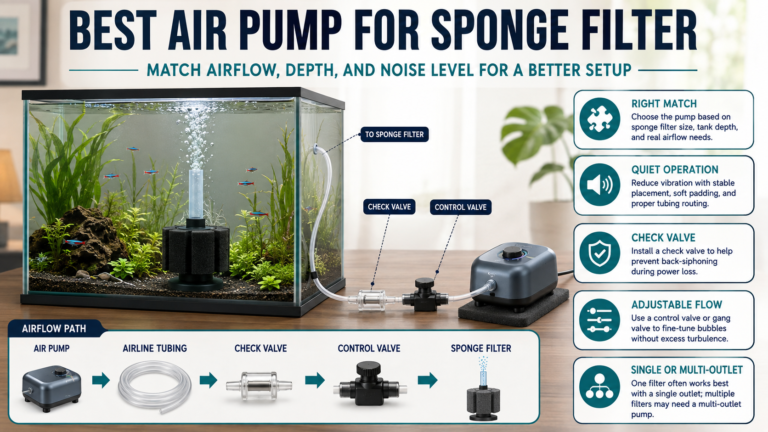
Choose a pump that comfortably meets the airflow you need without running at its limit. Then isolate vibration with a soft pad and keep tubing from touching the cabinet.
Most aquarium air-pump noise is a combination of motor vibration, resonance through the furniture and a pump working harder than it should. The quietest setup therefore depends on both the pump and how it is installed, not just the noise claim printed on the box.
Quick picks
These options cover common single- and multi-output styles. Compare required airflow, outlet count and adjustability, then leave enough capacity that the pump does not need to run at its absolute limit all day.
| Product | Best for | Why it stands out |
|---|---|---|
| Tetra Whisper Air Pump | Best familiar choice | A widely used air-pump line aimed at everyday aeration and sponge-filter duty. |
| hygger Quiet Aquarium Air Pump | Best adjustable option | A modern air-pump family with models that emphasize quieter running and adjustable output. |
| EHEIM air pump 100 | Best premium compact pump | A compact air pump from an established aquarium-equipment manufacturer. |
Tetra Whisper Air Pump
A widely used air-pump line aimed at everyday aeration and sponge-filter duty.
- Multiple sizes
- Simple setup
- Suitable for air stones and sponge filters
Price and availability can change. Check the retailer for current details.
hygger Quiet Aquarium Air Pump
A modern air-pump family with models that emphasize quieter running and adjustable output.
- Adjustable airflow
- Low-noise design
- Multiple outlet options
Price and availability can change. Check the retailer for current details.
EHEIM air pump 100
A compact air pump from an established aquarium-equipment manufacturer.
- Compact size
- Stable output
- Established aquarium brand
Price and availability can change. Check the retailer for current details.
How to Choose a Quiet Aquarium Air Pump
Size the pump for the actual back pressure created by the airline, check valve, depth and air stone or sponge filter. A properly sized pump on a soft, level surface can be dramatically quieter than an undersized unit vibrating against a cabinet wall.
Output headroom
A pump with modest reserve capacity can often run comfortably at a lower setting. An undersized pump pushed against deep water or restrictive stones may become louder and deliver inconsistent airflow.
Vibration control
Do not let the pump touch the aquarium glass, wall or a hollow cabinet panel. Soft rubber feet, a silicone mat and a short gap around the housing reduce the surfaces that can amplify vibration.
Number of outlets
If you run two sponge filters or multiple tanks, choose enough outlets or use a proper manifold. Splitting a tiny pump repeatedly can reduce performance and make balancing airflow frustrating.
Back-siphon protection
A check valve is inexpensive protection when the pump sits below the waterline. Install it in the correct direction and inspect it occasionally instead of assuming it will remain clear forever.
What matters in a real setup
Noise ratings are difficult to compare because the room, surface and tubing all change what you hear. A pump that is quiet on foam can buzz loudly on a hollow wooden cabinet.
Listen for where the noise is coming from before replacing the pump. A rattling lid, airline tapping the stand or air stone pressed against glass can sound like a bad motor. Isolating those contact points may solve the problem for almost no cost.
Setup and maintenance tips
- Place the pump on a dense foam or silicone pad.
- Keep it away from cabinet walls that can amplify vibration.
- Use a check valve and leave a drip loop in the power cord.
- Clean or replace clogged air stones before assuming the pump is weak.
Place the pump on a firm but vibration-damping surface with open airflow around it. Keep the airline free of kinks and position air stones so they do not buzz against glass or hardscape.
Common mistakes to avoid
Buying an oversized commercial pump for one nano tank. The better approach is to preserve control and visibility. Small freshwater setups usually reward gradual, deliberate maintenance.
Letting the pump touch a resonant cabinet wall. This can add unnecessary stress or cleanup. Choose the gentler method first and increase intensity only when the tank clearly needs it.
Ignoring clogged stones that force the pump to work harder. It is safer to solve the specific problem than to overcorrect the whole aquarium. Keep the adjustment proportional to what you are actually seeing.
FAQ
Why is my aquarium air pump suddenly loud?
Check for a hard contact point, clogged air stone, kinked tubing or worn diaphragm.
Can I put an air pump inside the cabinet?
Yes if it has ventilation and is isolated from surfaces that amplify vibration.
Do I need an air pump if I have a filter?
Not always. A filter that provides good surface movement can handle gas exchange on its own.
Final verdict
For a quiet setup, buy enough pump for the job and spend five minutes on placement. Vibration isolation often makes a larger difference than changing brands.
Check the current outlet count, airflow controls and recommended aquarium use before buying. The quietest result comes from correct sizing plus vibration isolation, so leave room in the budget for good airline, check valves and soft mounting.