A sponge filter is simple, shrimp-safe, and dependable, but its performance depends on a properly matched air pump. The best air pump for sponge filter is not automatically the largest or quietest option. It is the one that can provide steady airflow at your tank’s water depth, through the tubing and valves you plan to use, without producing excessive vibration or making maintenance difficult.
When comparing pumps, start with the filter’s air requirement and your aquarium layout rather than the tank’s gallon rating alone. Tank size matters because it helps determine the sponge filter’s size and stocking needs, but lift height, outlet count, and accessories also affect real-world airflow.
Start With the Sponge Filter and Tank Size
Choose the sponge filter first, then size the pump around it. A small single-sponge filter in a lightly stocked nano aquarium needs far less air than a large dual-sponge unit supporting a heavily stocked community tank, fry grow-out tank, or quarantine aquarium.
Look for the filter maker’s recommended airflow range when it is available. Then compare that requirement with the pump’s stated output. Keep in mind that a pump’s headline output is commonly measured with little or no resistance. Actual airflow drops as the pump pushes air deeper into the aquarium and through tubing, check valves, gang valves, and airstones.
| Setup | What to prioritize | Practical pump approach |
|---|---|---|
| Small aquarium with one compact sponge filter | Gentle, adjustable flow and low vibration | Use a modest single-outlet pump with enough reserve for the filter at tank depth. |
| Medium community tank with one larger sponge filter | Steady lift and enough output at depth | Choose a pump with capacity beyond the filter’s minimum stated need. |
| Two filters on one aquarium or two nearby tanks | Independent adjustment at each line | Use a multi-outlet pump or a pump feeding a properly adjusted manifold. |
| Breeding, fry, or quarantine setup | Reliable operation and backup planning | Favor a simple setup, easy replacement parts, and a separate emergency air plan. |
A larger pump is not always better. Excess airflow can make a sponge filter sputter, create unnecessary surface agitation, disturb delicate fry, or add noise. Select capacity with room to adjust downward safely rather than trying to force a powerful pump to run at its absolute minimum.
How to Choose the Best Air Pump for Sponge Filter
Compare pumps using the information that affects the air reaching the filter, not just marketing labels such as “for up to” a certain tank size. A suitable pump should deliver consistent bubbles at the installed depth while leaving some adjustment range.
Check output and operating depth
Airflow may be listed in liters per minute, gallons per hour, or another manufacturer-specific format. Use those numbers to compare pumps from the same listing method, but treat them as a starting point. The relevant question is whether the pump maintains usable flow once the airline reaches the bottom of your aquarium.
For example, imagine a sponge filter whose instructions call for 1.5 liters per minute. A pump advertised at 2 liters per minute may be adequate in a shallow tank with a short, direct airline. In a deeper aquarium with a check valve, a long run of tubing, and a splitter, that same pump may have very little useful reserve. A higher-capacity model with adjustable flow, or one dedicated to that filter alone, is the safer comparison.
Look for usable adjustment
An integrated dial can be convenient, but it is not the only way to manage flow. An external gang valve can divide and fine-tune air to separate filters. Do not assume every adjustment method is equally suitable for every pump. Excessively restricting all available outlets can increase backpressure, so follow the pump manufacturer’s guidance and use a bleed line or appropriate manifold when needed.
Decide Between Single and Multiple Outlets
A single-outlet pump is often the cleanest option for one sponge filter. Fewer connections mean fewer places for leaks, kinks, and uneven airflow. It is also easier to see whether the filter is receiving the intended amount of air.
Multi-outlet pumps are useful when running two or more filters, but the outlets may not always perform identically. Some pumps have separately controlled outlets, while others divide one internal air supply. Read the product details carefully instead of assuming each outlet receives the full advertised output.
- One filter: A dedicated single outlet is usually simple and easy to tune.
- Two filters in the same tank: Use separate lines and a gang valve if individual adjustment is needed.
- Several tanks: A multi-outlet pump can reduce clutter, but a leak or failure may affect every connected aquarium.
- Long airline runs: Account for added resistance and keep tubing as short and direct as practical.
When splitting one pump between filters, balance the lines. A short line may receive more air than a longer or deeper line. Adjust the more easily supplied line first, then verify that the more demanding line still produces a stable bubble stream.
Consider Noise, Vibration, and Placement
Many air pump complaints are caused by vibration transfer rather than the pump’s motor alone. A pump placed directly on a hollow stand, glass lid, or hard shelf can turn a small hum into a noticeable rattle.
Place the pump on a stable surface above the aquarium’s waterline whenever possible. A soft, dry pad beneath it can reduce vibration, provided it does not block ventilation openings. Keep the pump away from splashes, high humidity, and locations where it can be knocked into water.
- Keep airline tubing free of sharp bends and pinches.
- Avoid trapping the pump inside a sealed cabinet where heat can build up.
- Make sure the tubing does not pull the pump toward the aquarium edge.
- Inspect for loose lids, cabinet doors, or objects that may rattle against the airline.
Do not bury a noisy pump under towels or other materials to muffle it. Restricting ventilation can encourage overheating and makes it harder to notice leaks or damage. Instead, address the surface vibration, pump placement, and tubing route.
Use Check Valves and Control Valves Correctly
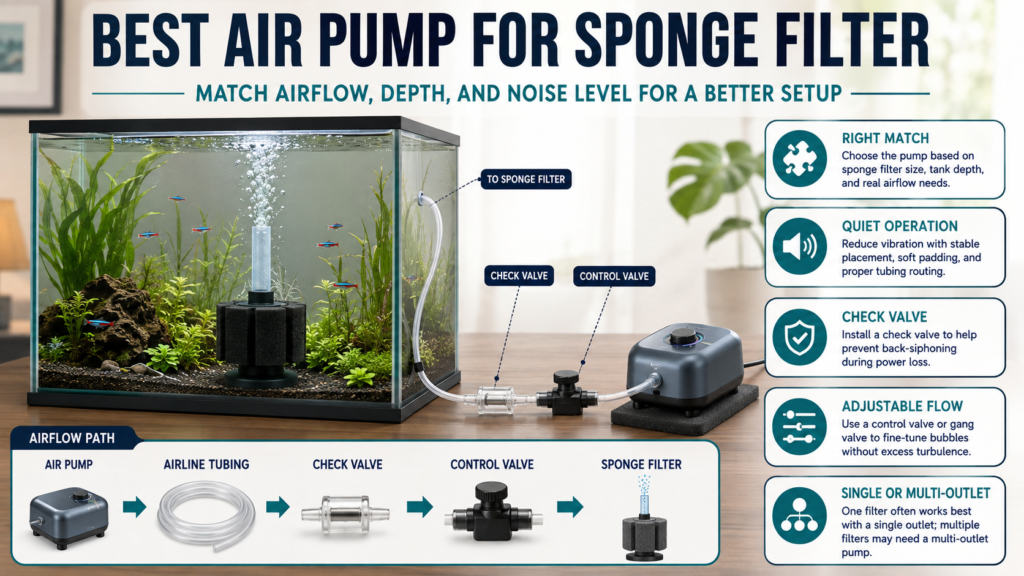
A check valve is inexpensive protection against back-siphoning. If power fails and the pump sits below the aquarium waterline, water can travel down the airline toward the pump. Install a check valve in each airline, with the directional arrow pointing from the pump toward the aquarium.
Place the check valve outside the aquarium and where it is easy to inspect. Test it before relying on it: disconnect the airline from the pump side while the aquarium end remains submerged, then confirm that water does not travel through the valve. Replace a valve that leaks, sticks, or becomes difficult to blow through in the correct direction.
A control valve or gang valve helps tune airflow, especially with multiple filters. Install it where you can reach it without moving the aquarium. Make small changes, wait for the bubble stream to settle, and avoid closing every path so tightly that the pump is working against a fully restricted line.
Set Up the Air Line for Reliable Daily Operation
- Position the air pump above the waterline if the location allows it safely.
- Cut airline tubing to a practical length with gentle curves rather than tight loops.
- Install a check valve in the correct direction on each line.
- Connect the tubing firmly to the sponge filter’s uplift tube or air inlet.
- Run the pump and adjust airflow until the filter produces a consistent lift of bubbles and visible water movement from the uplift tube.
- Observe the setup after a few minutes and again after several hours for kinks, disconnected tubing, uneven output, or excessive noise.
Use the aquarium’s behavior as a final check. The sponge filter should circulate water through the sponge and provide surface movement without turning the tank into a turbulent bubble column. If fish are constantly pushed by current or fry are drawn into a strong localized flow, reduce air gradually or reconsider the filter and pump pairing.
During maintenance, inspect the tubing and valves along with the sponge. A clogged sponge can change water movement, while aging tubing can harden, crack, or loosen at connections. Replacing inexpensive airline components before they fail is easier than troubleshooting a weak filter during an urgent situation.
Plan Redundancy for Higher-Risk Aquariums
For a typical lightly stocked display aquarium, a spare diaphragm kit or replacement pump may be enough preparation. For heavily stocked tanks, breeding systems, quarantine tanks, or any setup where oxygenation and biofiltration are especially important, plan for an air interruption before one happens.
A dual-outlet pump can provide convenience, but it is not full redundancy if both outlets depend on the same motor and power source. More meaningful backup may include a separate battery-powered air pump, a second independently powered pump, or an emergency plan appropriate for your aquarium’s stocking level and expected outage risks.
The best air pump for sponge filter setups is therefore one part of a reliable system: correctly sized, easy to adjust, protected by a check valve, placed safely, and supported by a realistic backup plan.
Frequently Asked Questions
Can an air pump be too strong for a sponge filter?
Yes. Excess airflow can create unnecessary turbulence, noise, and stress for delicate livestock. Choose adjustable capacity or use a suitable control method to tune the bubble rate without fully blocking all outlets.
Do I need a check valve if my pump is above the aquarium?
It is still good insurance. Placement above the waterline reduces back-siphon risk, but a check valve adds protection if tubing shifts or the pump is moved during maintenance.
Can one air pump run two sponge filters?
Yes, if it has adequate output at the required depth and each line can be adjusted. Use separate tubing runs and verify that both filters maintain consistent airflow after tuning.
Why is my sponge filter producing weak bubbles?
Check for kinked tubing, a clogged or reversed check valve, an overly restricted control valve, a dirty sponge, or a pump that lacks enough output for the aquarium’s depth and number of connected lines.
Helpful products to compare
Use the buying criteria above to compare suitable options for your needs.